

Now, I’m thinking that I’ll finally retire (completely) early next year and as travel is a passion think maybe South America for a month would be a treat for the wife and I. I’ve always wished I could dance but ‘Dad Dancing’ is my only specialty, Oh to be a Tanguero!
So staying out until 3am! What would your mother say?
Well I say I too am looking to grow old disgracefully!
There is of course dancing just for the fun of it but there is evidence based research too!
According to new research by the University of Leeds, “Regular dance sessions can benefit people over 85 by helping them be physically active, socialise, and reconnect with their younger selves.” Getting involved with any kind of physical activity later in life can be beneficial. If Tango ain’t your thing, what about Ballet?
A new start after 60: ‘I took up ballet at 62 – and it transformed my life’
The benefits of dance for older people
I poached this from Westgate Healthcare so thanks to them! Maybe pay them a visit!
We all know how wonderful dancing can make us feel, whether we’re shaking our stuff at the local nightclub or jiggling along to the radio in the kitchen. It releases endorphins, gives you a great work out and always brings a smile to your face too. But dance is not just for the young ones.
The older generation were brought up on dance. With no Tinder or Match.com to help them find a partner, being a great dancer was the best way to ensure you got a date with the hottest guy or gal in town, and many older adults were very talented movers in their day.
Although they might not remember the steps to the tango, or be able to foxtrot as fast as they used to, that doesn’t mean older people shouldn’t be encouraged to move and groove their cares away. Here are just a few of the proven benefits dance can have for older people:
- Strength
Time and again, dance has proven to be one of the best ways to maintain and improve muscle strength as we age, combatting the typical muscle loss that comes with age. Dance can also improve balance and coordination, making people less likely to fall and injure themselves too. - Pain relief
A study in the USA found that people who relied upon pain medicines to cope with knee and hip discomfort were actually able to reduce the amount of medication they took as a result of a dance programme. The programme lasted 12 weeks, and by the end of the period, participants were able, on average, to reduce their pain relief medicine by over a third (39 per cent). - Dementia defence
It’s well known that exercise can help reduce the risk of developing dementia, but dance appears to be one of the best forms of exercise for this. Experts believe that the combination of cardiovascular exercise and split-second decision-making challenges the neural network, causing it to forge new pathways and thereby stave off mental decline. - Social connections
Dancing can be done alone, but it’s much more fun in a group. People who take up line dancing classes, Zumba, or any other form of group dance activity will make new friends and become more involved in their local communities. These social connections are increasingly important as we age, and can help us to stay supported and included also. - Mood boosting
Numerous studies have proven that dance can be beneficial for staving off depression and anxiety. Healthy, mood boosting endorphins will be released with any type of exercise, but because dance is a social activity too, this is augmented to give dancers a really positive boost following their session.
One of the greatest things about dance is that anyone can join in. We might not all be able to pirouette like Darcey Bussell, but there is a dance for everyone and everyone is welcome to dance. Parkinson’s, dementia, cancer, heart disease, arthritis… none of these issues will stop anyone from dancing, so if you’ve got an older person in your life who could benefit from busting a move, grab them by the hand and dance!


Victoria Zaragoza-Martinez was retired, with little to do except hate the miserable British winter. At 71, she decided to bring some Latin warmth into her life.
Victoria Zaragoza-Martinez was 71 when she danced the tango for the first time. Growing up in Mexico, she had always had an affinity for the South American dance but never learned the proper steps. It wasn’t until 2015, soon after she had retired from being a teacher and translator, that Zaragoza-Martinez found herself at a class in Oxford being led around the room to a sprightly tango rhythm. “I just left all my troubles behind because the music took over,” she says. “Once you dance, all you want to do is dance.”
For the past nine years, Zaragoza-Martinez has been dancing the tango at least once a week. She has made a new group of friends that she sees at milonga dance parties and has even travelled to Argentina to tango with the locals. Despite now being 79 and the oldest in her group, Zaragoza-Martinez sees the dance as vital to her health and lifestyle. “I don’t feel almost 80 when I dance,” she says. “It’s my life’s passion.”
It has been a long journey to the dancefloor for Zaragoza-Martinez. Born in Spain, she emigrated as a child with her family to Mexico and at 19 became a teacher to help support her single mother. “I used to enjoy dancing Spanish traditional dances but didn’t have time to learn anything else,” she says. “I always had to work, and while I’d loved tango music since I was a baby, I never knew what to do when it came on.”
After meeting her British husband at a mutual friend’s wedding, Zaragoza-Martinez moved to England in 1981. She spent her days teaching Spanish and the school holidays travelling, and the decades soon passed without her having an opportunity to dance again. Before she knew it, Zaragoza-Martinez was retired.
“I had a lot of time on my hands and I resented the length of the miserable winter,” she says. “It became my worst enemy.” Respite came when her friend Maria suggested she join her weekly Ceroc dance classes. “She had been encouraging me to go for a while,” she says. “I didn’t want my age to control my life, I wanted my life to control my age. So I knew I had to try something new.”
I am grateful for the warm embrace of dancers, and it’s always fun to go to charity shops and dress up for the occasion
At Ceroc, where attendees learn a fusion of ballroom styles, Zaragoza-Martinez found herself slipping easily into a dancefloor rhythm. She gradually built up her skill but something was missing. “After a year, the classes had moved to a venue further away and I didn’t enjoy driving there at night,” she says. “At one rehearsal, I overheard two dancers talking about tango lessons nearby and a lightbulb went off in my head.”
Replacing her night-time commute with a 10-minute trip to daytime sessions at the Oxford Tango Academy, Zaragoza-Martinez finally began learning to tango. “It was such an incredible experience, and many of the people in my class were over 60,” she says. “Still, it took me a year to perform at the social dances. I was worried I wouldn’t be able to follow the leader or that no one would choose me to dance with.”
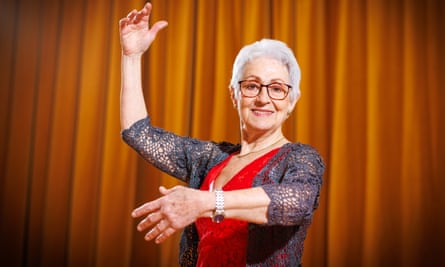
Encouraged by her fellow beginners, Zaragoza-Martinez gradually built up her confidence and went to her first milonga, where she danced for five hours. “When I’m at a milonga, the music envelops me and there are no aches or pains in my body,” she says. “I am grateful for the warm embrace of dancers – and it’s always fun to go to charity shops and dress up for the occasion.”
Indeed, Zaragoza-Martinez has built up a wardrobe of salvaged tango ballgowns, some only costing £3, and despite never being able to stand heels before dancing, she can now keep her tango shoes on all night. In 2022, she put that stamina to the test by travelling with a group of dancers to Buenos Aires and visiting the tango clubs each night until 3am. “It was amazing to go to the birthplace of tango,” she says. “Dancing has really encouraged me to be adventurous and added a new light to my life.”
Although her husband doesn’t dance, he encourages Zaragoza-Martinez and often drops her off at the milongas she attends up to five times a month. As she approaches 80, she has no plans to slow down. “I wish I had started learning sooner, but it was impossible,” she says. “I’m now making up for lost time and forgetting my age!”
Tell us: has your life taken a new direction after the age of 60?
 It's the Time Of Your Life