
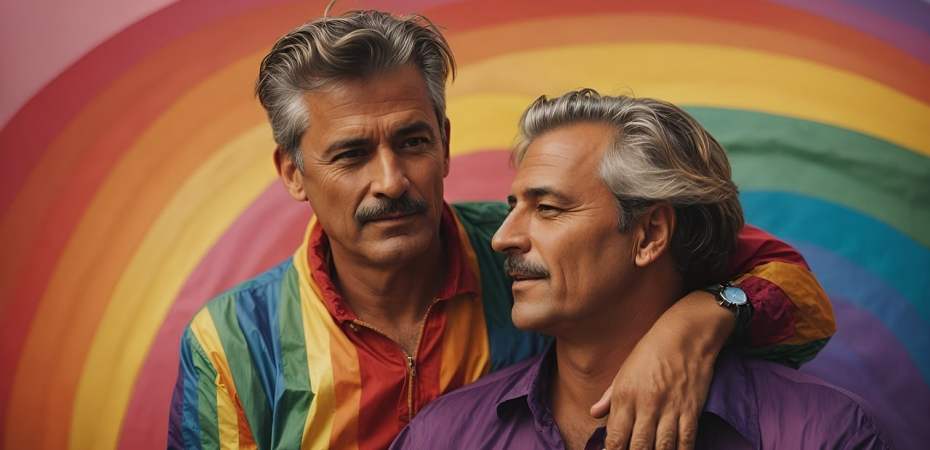
Isn’t life crazy?! We live in a generally accepting civilisation but still some find it difficult to live their lives as their true selves, or is it that not knowing or understanding who or what we are so follow a pre-destined path or at least one of least resistance. Hiding who one really is must be difficult but one could argue that now one seems almost obliged to identify as to who we really are. Have many of us identified as having the gender and sex we were born with because we knew not how to accept repressed feelings that didn’t fit with who we thought we were or could be? I’m not sure why the CIS and TRANS terms fit into this except that these were terms I learned to use in chemistry to describe isomers – In the context of chemistry, where cis indicates that the functional groups (substituents) are on the same side of some plane, while trans conveys that they are on opposing (transverse) sides.
Homosexuality may have been legal, or at least not illegal in days gone by. Post 597 AD, Christianity and homosexuality began to clash. Same-sex male sexual activity was characterised as “sinful” but not illegal. Under the Buggery Act 1533 male anal sex was outlawed and made punishable by death. LGBT rights first came to prominence following the decriminalisation of sexual activity between men, in 1967 in England and Wales, and later in Scotland and Northern Ireland. Sexual activity between women was never subject to the same legal restriction. It is interesting that an elderly relative just couldn’t believe there could ever be such a thing as lesbianism, to her it just didn’t seem possible! We’ve come a long way since and many have found, accepted and celebrated their true selves late in life. Many of the young are finding that their sex and gender are a mismatch and society is more accepting, albeit many remain confused and have difficulty accepting that others feel they are of a different gender to that expected by their X & Y chromosomes and many religions still stick to their doctrines and remain steadfastly rigid in their belief that LGBTQ+ brethren are somehow sinful.
Mike Parish hid his sexuality at work and wouldn’t even hold Tom’s hand in the street. How did he end up running an LGBTQ+ support group?

Mike Parish was 19 and on the escalator at Victoria station in London when a tiny sticker caught his eye. As he read the words “Do you think you’re gay?”, the escalator whisked him downwards. He had to go back up and then down again to copy the phone number, which was for an organisation called Icebreakers. This act proved a turning point for Parish, who had increasingly felt at odds with how he fitted into the world.
It took weeks to brave dialling the number. “I think I’m gay, but I don’t want to wear a dress and carry a handbag,” he told the man at the end of the line; it was 1974 and now, aged 68, Parish looks back and is saddened by his own lack of knowledge. The man laughed and invited him to a tea party the following Sunday. Sitting on the sofa there, he reached for his cup of tea at the same time as a young man on the other end of the couch. They smiled at each other. “I fell for Tom in that moment,” Parish says.
He and Tom were together for more than 40 years, until Tom died of dementia last year. Now, Parish has launched a community interest company to support LGBTQ+ people with dementia and their carers.
“The trouble is, for a lot of people who, like me, are approaching 70 or older, the negative experiences they had when they were younger are still there. It’s like going through some sort of crisis – you never forget it,” Parish says.
For years, he hid his sexuality at work; he spent four decades in the fire brigade, mostly as an emergency planning officer. One year, terrified that he had slipped up, he opened all the Christmas cards he had written to check that he hadn’t added Tom’s name to them.
Although they had a civil partnership in 2006, in public the pair were guarded and avoided holding hands. “Too frightened,” Parish says. “People got attacked in the street because they were gay. This happened so much in our early lives … The trouble is when someone says: ‘Look, a couple of queers’, you don’t know if the next thing is going to be a brick or a punch.”
But Tom’s dementia, and Parish’s duty of care, led them into new territory. A few years ago, they would go for coffee in Bath, Somerset. “And I would hold his hand,” Parish says. “He would fall over if I didn’t.” Sometimes passers by said unpleasant things, but Parish called them out, once challenging a builder: “Yes, we are together. He’s my husband.”
Parish says: “I spent a lifetime frightened, but as Tom got ill, my fear of doing anything publicly evaporated. I have no fear any more. It’s a good place to be.”
As an increasing number of social workers and care workers visited their home, Parish learned to advocate, challenge and question. The case of Ted Brown, whose partner experienced homophobic abuse in a care home, weighed on him. Online research suggested the problem was widespread. So, at 59, Parish retired to care for Tom at home. But sometimes people would see him feeding Tom and remark: “It’s wonderful how you look after your father.”
“I became a carer’s voice,” Parish says. “I wanted to say: ‘Look, when you go out as a social services officer and there are two men, or two women, don’t assume.” He began to give talks to local organisations. When he contacted Deep, the UK network of dementia voices, and asked if there were any LGBTQ+ dementia groups, he was told: “Not really. Why don’t you start one?”
Last year, with a few like-minded people he has met along the way, Parish co-founded the LGBTQ+ Dementia Advisory Group, to “improve the lives of LGBTQ+ people who are affected by dementia”.
Parish knows that he may need help himself one day. But he is mostly spurred on by the memory of Tom. “I gained some kind of confidence from somewhere, some kind of drive,” he muses. “And the inspiration for that came from Tom.” He understands the meaning, he says, of the words: “I’ll do anything for the person I love.
“When you’ve got that level of freedom from the things that would normally hold you back, nothing can get in your way.”
 It's the Time Of Your Life